
House Extension Cost Estimating Services UK
Getting three quotes from builders and picking the middle one is not a cost plan. It's a gamble. Our extension estimating service gives you an independent, professional breakdown of what your project should cost, before contractors get involved.
What Makes Extension Costs So Hard to Pin Down
The honest answer is that extension costs are genuinely variable, and not in a way that's easy to explain to a client without sounding evasive. Two identical 30m² rear extensions on the same street can cost 25–30% different depending on what the builder finds when they open up the existing structure.
Then there's the specification problem. Most builder quotes cover the shell only, walls, roof, windows. What they don't include upfront: steelwork for structural openings, underfloor heating, bi-fold door installations, kitchen or bathroom fit-out, and the M&E first and second fix. By the time those get added, a quote that looked competitive suddenly isn't.
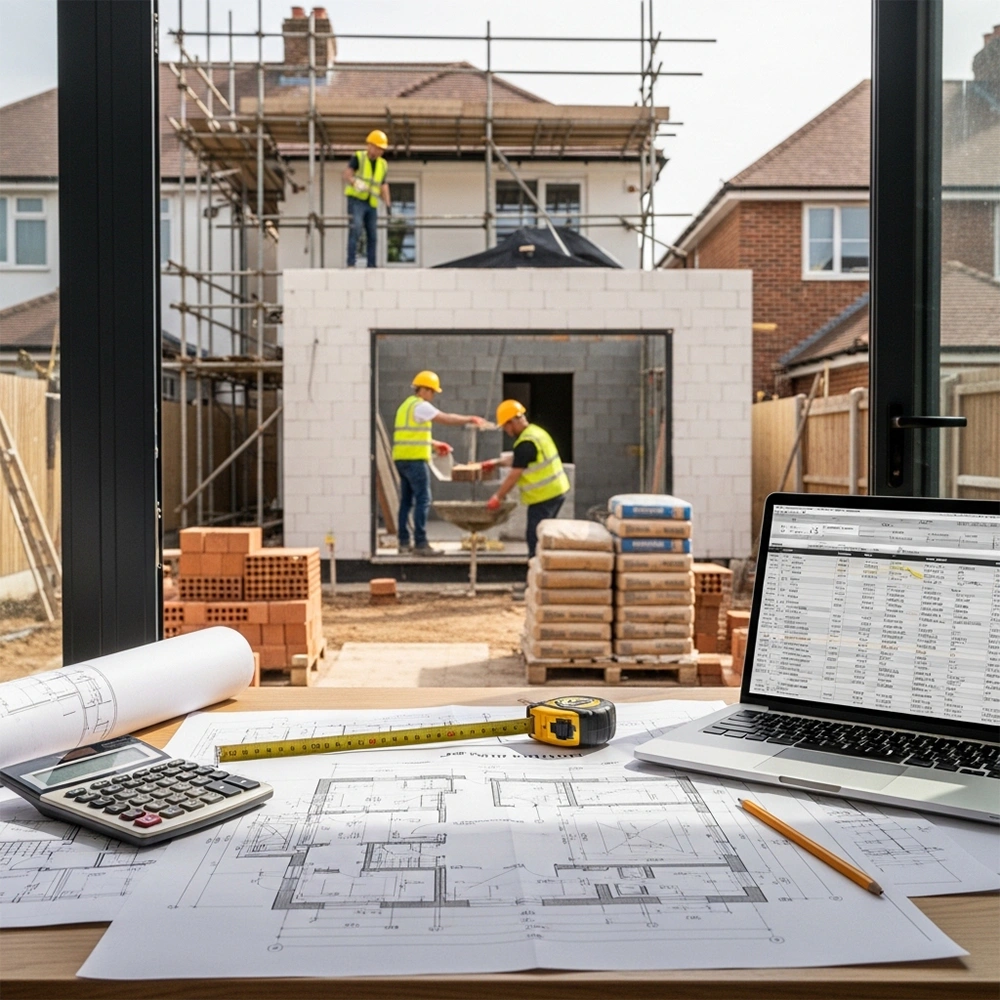
Our job is to define the full scope from the beginning. We work from your architectural drawings and a clear specification, and we produce a cost plan that covers every element, not just the bits that are easy to price. That way you go to tender knowing what the whole job costs, and you can compare contractor quotes on a like-for-like basis.
Our residential construction cost estimating covers extensions of all types and sizes across England, Scotland, Wales, and Northern Ireland.
The most common mistake we see: homeowners approve a builder's quote based on the shell cost, then face a series of additional charges mid-construction for steelwork, drainage diversions, and fit-out items that were never included. A proper cost plan removes that risk entirely.
We also give you a clear contingency recommendation, typically 10–15% on extension projects, based on the specific risks on your job, not a number pulled from thin air. Older properties, complex party wall situations, and steep sites all carry more risk, and your contingency should reflect that.
If you're also exploring a full renovation alongside your extension, see our house renovation cost estimates service, we regularly combine both into a single cost plan.
Extension Types We Estimate
We produce cost estimates for every type of residential extension. Each one has different structural requirements and cost drivers, here's what shapes the cost on each type.
Single Storey Rear Extension
The most common extension type. Key cost drivers are the structural opening into the existing house, roof specification (flat, pitched or lantern), and kitchen or living fit-out if applicable. Permitted development often applies, reducing planning cost.
Two Storey Extension
Better value per m² than single storey because foundations and scaffolding costs are shared across two floors. Planning permission almost always required. Cost complexity increases with the structural connection to the existing first floor.
Side Return Extension
Popular on Victorian terraced and semi-detached properties. Often involves a party wall agreement with the neighbour, which adds cost and programme time. The narrow site can also affect contractor logistics and access.
Wraparound Extension
Combines rear and side return into a single larger footprint. Highest cost per project but transforms ground floor layouts significantly. Structural complexity is greater, multiple steel beams and connection points to the existing structure.
What a Professional Extension Estimate Covers
A builder's quote and a professional cost estimate are not the same document. Here's what we include that most contractor quotes miss.
Planning, Permitted Development & Building Regs
The regulatory side of extensions affects both cost and programme. We flag all of this clearly in our estimates so nothing comes as a surprise.
Permitted Development
Many single storey rear extensions don't need planning permission. We confirm whether your project falls within PD rights and flag where it doesn't, saving you time and planning fees where possible.
Party Wall Agreements
If your extension sits on or near a boundary, a Party Wall Agreement is legally required. We include a provisional allowance for this in estimates where relevant, it's a cost many homeowners miss entirely.
Building Regulations
All extensions require Building Regulations approval covering structure, insulation (Part L), fire safety, and drainage. We build current regulations compliance into our specifications, not as an afterthought.
Why Get an Estimate Before Going to Tender
Most homeowners go straight to builders. In our experience, that rarely ends well, not because builders are dishonest, but because without a defined scope, every contractor is pricing something slightly different.
You know the full cost before you commit, no mid-build surprises when the steelwork or drainage diversion wasn't in the original quote
Contractor quotes become comparable, everyone is pricing the same scope, so a lower quote actually means lower cost, not fewer inclusions
You negotiate from a position of knowledge, when you know what things should cost, you can push back on inflated items with evidence
Your lender or financial advisor has a document they can rely on, particularly important if the extension is being funded through remortgage or a development loan
House Extension Estimating FAQs
Do I need full architectural drawings before you can produce an estimate?expand_more
How long does it take to get an extension cost estimate?expand_more
Will your estimate include the party wall surveyor fee?expand_more
Can you estimate an extension if it includes a new kitchen or bathroom?expand_more
We're extending and renovating at the same time, can you cover both?expand_more
Related Residential Estimating Services
Ready to get your extension properly costed?
Send us your drawings and brief. We'll confirm scope and turnaround within 10 hours and have your estimate ready in 3–7 days.